Deals don't die at the appointment. They die in the two days after it.
Ask a water treatment dealer where they actually lose business and almost nobody says the kitchen table. They say the follow-up.
The pitch goes fine. The test strip makes its point. The homeowner nods at the right moments. Then the rep gets back in the truck and the proposal breaks into pieces — the presentation in one email, the invoice in another, the agreement in a third. Each attachment arrives stripped of the walkthrough that made it make sense, and the customer opens whichever one is on top. Usually the one with the number on it.
Meanwhile, the person who most often needs convincing never saw any of it. The spouse who was at work. The partner who "handles the money." They get a price relayed secondhand across the kitchen counter, with none of the reasons it was worth paying.
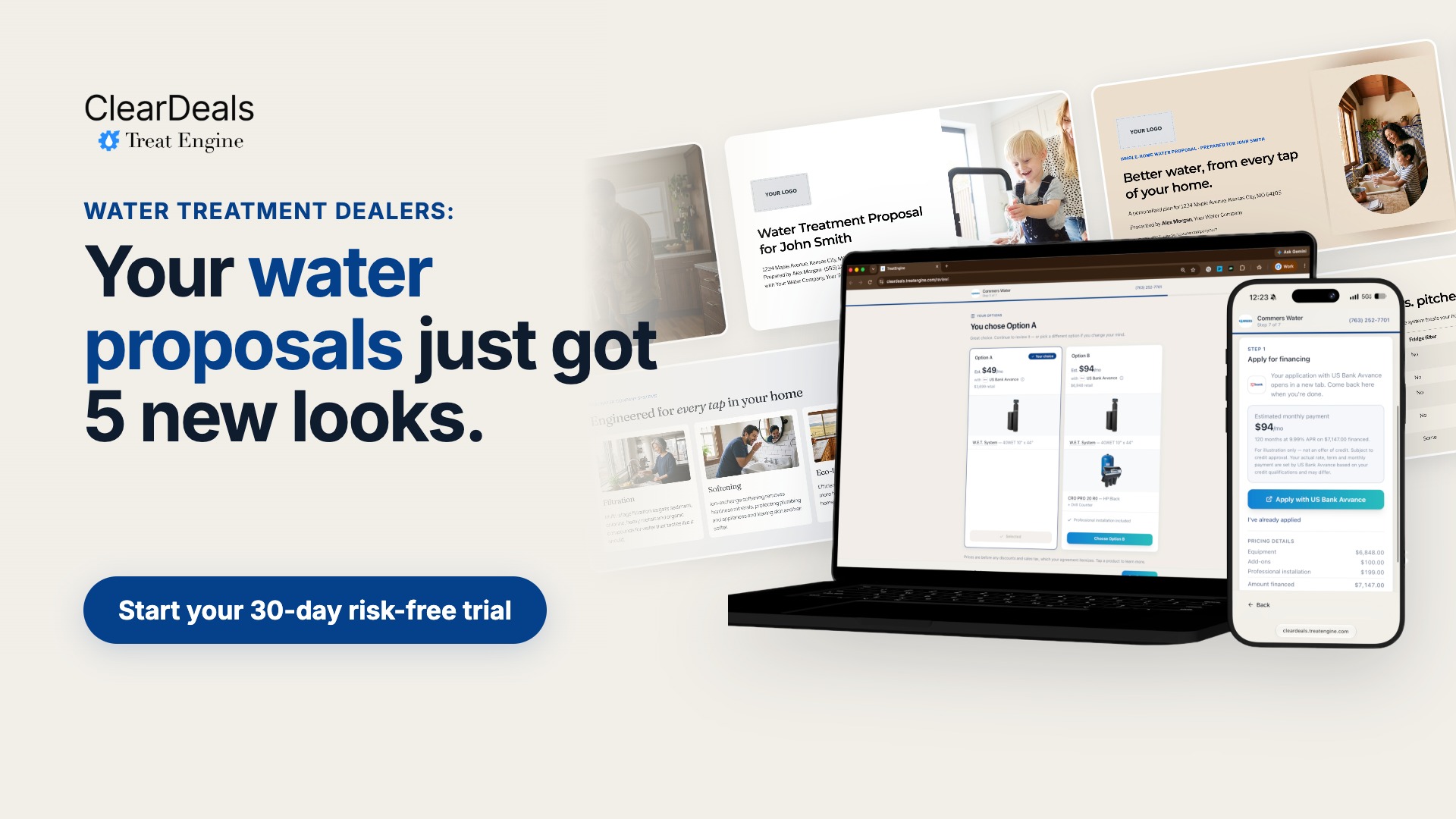
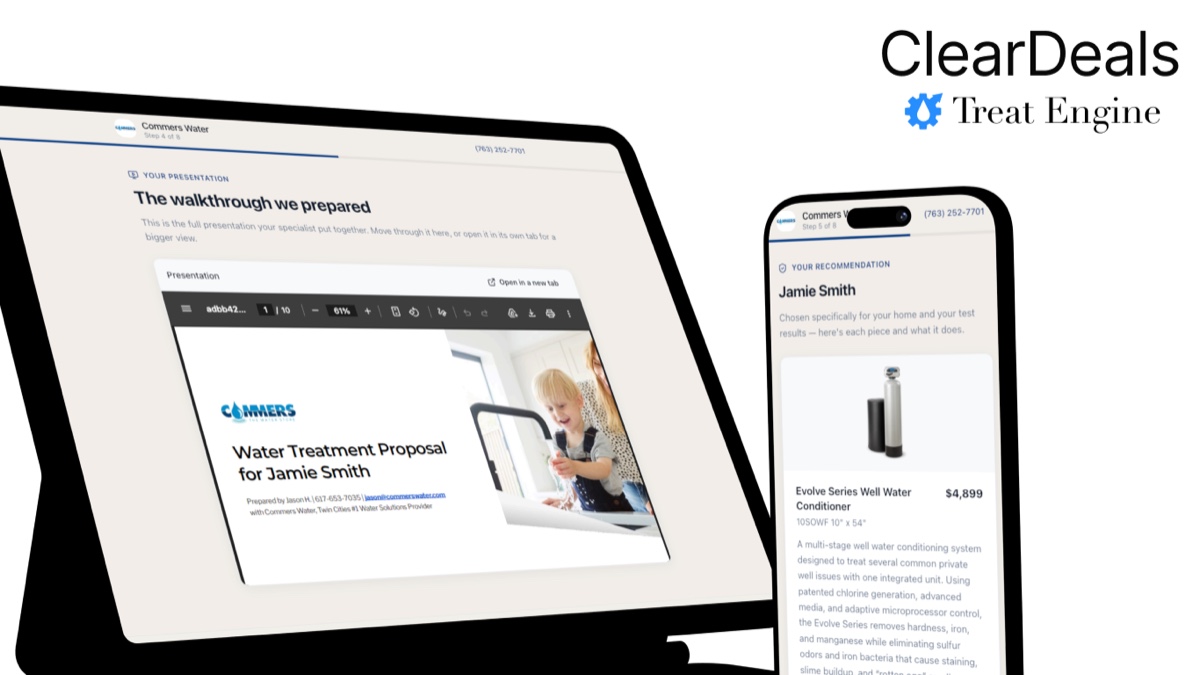
That's the gap the ClearDeals Guided Proposal closes — an interactive proposal for water treatment sales that the homeowner moves through on their own. Every proposal your reps build in ClearDeals can now be handed over as a single link — welcome, water test, presentation, recommended system, savings projection, maintenance plan, invoice, and signature, in that order, on one page.
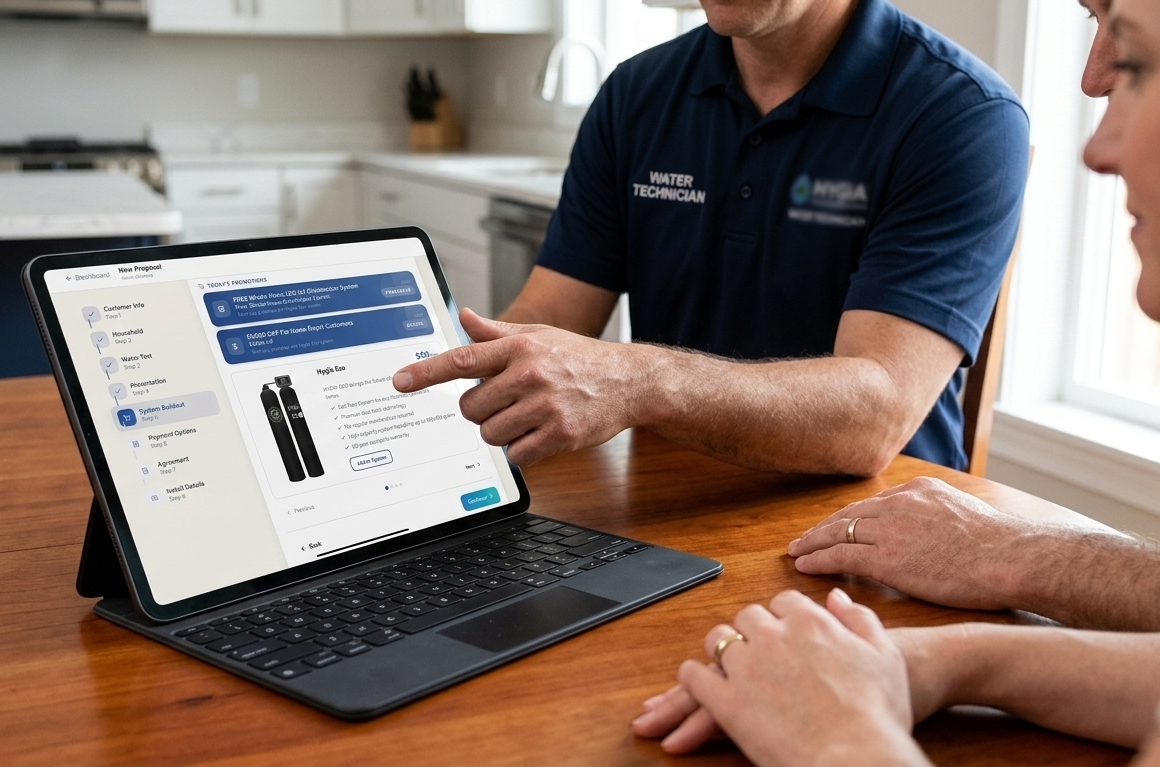
To be clear about what this is and isn't: ClearDeals is an in-home sales tool for residential water treatment dealers, and it stays one. The tablet at the kitchen table is still the point. Nothing about how your reps run an appointment changes. What changes is what happens when the appointment doesn't end in a signature — and what your team can do when someone has to sell a job they can't drive to.
What is an interactive proposal?
An interactive proposal is a sales proposal the customer opens and moves through themselves, in an order you control, instead of receiving a static PDF or a folder of attachments. It lives at a web address rather than in a file, so it works on a phone, updates when the deal does, and can be signed at the end without a second link.
For water treatment sales specifically, that means the homeowner walks through their own water test results, the presentation their rep built, the system that was recommended for their house, the twenty-year savings math, and the agreement — as one page, at their own pace, with the sign button waiting at the bottom.
The difference that matters isn't that it looks better than a PDF. It's that a PDF can be opened at the last page. An interactive proposal is built so the price arrives after the reasons for it.
Why the "email a stack of attachments" follow-up fails
The traditional water treatment sales follow-up asks the homeowner to do three jobs your rep should be doing for them: assemble the pieces, put them in the right order, and remember what each one meant.
In practice, four things go wrong every single time:
- The price arrives without the context. A PDF invoice opened cold is just a big number. The water test that justified it is in a different email, three messages down.
- The order collapses. Your presentation was built to earn its way to the price. Attachments destroy that sequence — the customer starts at the end.
- The decision-maker gets a summary, not a pitch. Forwarding attachments doesn't forward the appointment. Whoever wasn't home evaluates your system on hearsay.
- Signing requires yet another email. Even a motivated buyer has to wait for a separate e-signature link, which means another day of drift.
Every one of those is friction that has nothing to do with whether your system is right for the house. It's just packaging — and packaging is the cheapest thing in your sales process to fix.
One interactive proposal instead of a stack
Open any proposal in ClearDeals and hit Share. Instead of assembling an email, you get a Guided Proposal — one link to a single page built from the proposal your rep already filled out during the appointment. Nothing to upload. Nothing to re-enter.
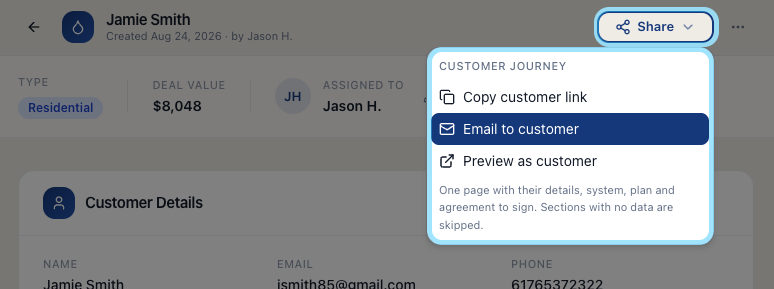
You can copy the link into a text message, email it straight from ClearDeals, or preview it first. Most homeowners open it on a phone, on the couch, after dinner — which is precisely the moment your follow-up email used to be losing to everything else in their inbox.
What the homeowner actually sees
The page is a sequence, not a folder — and it's the same sequence your rep just ran at the table. It opens on the homeowner's name and their own house, walks through their water test results in plain language, then plays the presentation your rep built right inside the page. From there it lays out the recommended system piece by piece, explaining what each one is there to fix.
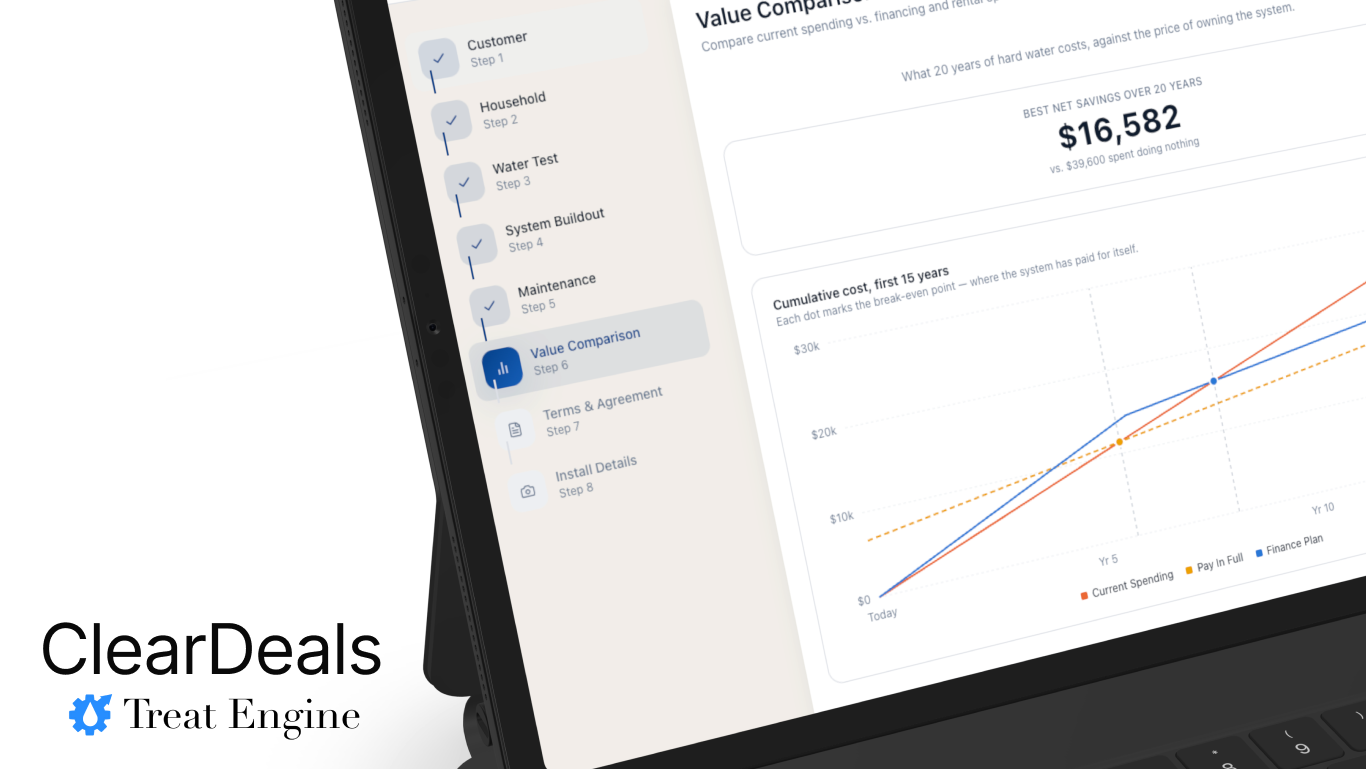
Only then does it get to money: what the system costs, and what twenty years of doing nothing costs beside it. The maintenance plan follows, with promotions already applied. The agreement, the Stripe invoice, and the signature sit at the end of that same page.
In other words, the homeowner re-runs the appointment in the order it was designed to be run, and arrives at the price with every reason for it already in hand — which is exactly what an emailed invoice can never do.
Sections with nothing behind them are dropped automatically. No water test on file, no water test section. The page is only ever as long as the proposal is real, so a rushed proposal doesn't produce a padded page full of empty steps.
Where this actually earns its keep
An interactive proposal isn't worth much in the abstract, so here's where it actually pays for itself. Two of these are ordinary in-home problems every residential dealer already has. The third is a door this opens if you want it.
1. The appointment that didn't close in the room
Your follow-up stops being an email with attachments and becomes the walkthrough again — on the homeowner's own time, with the sign button at the end of it. Instead of "did you get my email?", the next conversation starts from a customer who has already seen the savings math a second time, in the order your rep intended.
2. The decision-maker who wasn't home
The one-legger is the most expensive appointment in water treatment. Your rep did everything right and still has to hope the pitch survives being retold by a spouse over dinner. When the person who missed it gets the full presentation instead of a number, you stop losing deals to a conversation you weren't part of.
3. The job nobody can drive to
This one is a bonus rather than the point. A referral two hours outside your service radius, a rental owner who lives out of state, a lake house — appointments that were never worth the windshield time can now be run without one. Same story, same order, same close, delivered by a rep who never sits at that particular kitchen table. If you're not selling that way today, nothing changes. If you want to, the door is open.
The numbers stay the numbers
The fastest way to lose trust in a follow-up is a price that moves. Everything in the Guided Proposal runs the same pricing your Agreement step runs: stacked promotions, financing terms, state sales tax, and the maintenance plan. There's no second version of the math to keep in sync, so nothing shifts between what the customer reads and what they sign.
That includes the twenty-year savings projection. If you haven't seen how much work that one screen does in an appointment, it's worth reading why a side-by-side ROI projection closes deals at the kitchen table — the Guided Proposal is what lets that argument keep working after the rep leaves.
When the homeowner is ready, the Stripe invoice and the signature are right there. No second link. No second email. No let me send that over.
One caution worth passing to your team: a Guided Proposal link carries the ability to sign. Treat it exactly like any e-signature link — send it to the customer directly, not into a group thread or a shared inbox.
For the dealership owner: a follow-up you can actually standardize
It removes rep discretion from the worst possible moment. Follow-up quality is usually the widest performance gap on a sales team — your top closer sends a thoughtful recap, your newest rep sends three attachments and a "let me know." One link makes both follow-ups identical.
It protects the value story you already paid to build. The presentation, the water test, and the savings projection all survive the drive home instead of being flattened into a price quote — which is the entire argument for an interactive proposal over a PDF.
It converts appointments you've already bought. Every lead you generate has a fixed cost. Recovering even a fraction of the deals currently lost between the appointment and the decision is the cheapest revenue in the business — cheaper than more leads, and immediate.
Where to find it
On any proposal in ClearDeals: Share in the header, then Copy customer link, Email to customer, or Preview as customer — all three open the same Guided Proposal. It's live for every ClearDeals dealership today — there's nothing to turn on and nothing to configure.
Your reps don't have to learn anything new, either. They run the appointment exactly the way they run it now; the Guided Proposal is just one extra button at the end of a proposal they already built.
Send one this week
Take the next water treatment sales proposal you'd normally follow up on with three attachments and send an interactive proposal instead. Then watch how far the homeowner gets before they call you.
Most dealers find out the same thing: the customer didn't need more convincing. They just needed the pitch to survive the drive home.